Step off the slick pavement of Poland Street on a wet November evening, and Bubala Soho feels like it belongs to a different climate altogether. Outside, the West End is operating at full festive tilt: buses hissing, delivery scooters cutting through puddles, the fluorescent chill of Oxford Street retail bleeding down towards Soho. Inside, through a single deep window pulsing a peachy glow, sits a 50-cover vegetarian restaurant in Soho that has been built, quite deliberately, around the idea of light.
The approach is oddly cinematic. The door is heavy enough to be mentioned in most word-of-mouth accounts, and it is not simply a quirk of carpentry. It acts as a physical airlock. Push against its weight and the hiss of traffic, sirens and shouted conversations abruptly fall away. The temperature rises a notch. The background hum turns from street noise into controlled, low-frequency conversation and a soundtrack that leans on funk and lo-fi. Within a couple of paces, you have moved from hard-edged, anxious W1 to something softer, amber-toned and carefully tuned.
The room is long and narrow, a classic Soho townhouse footprint. Counter seats stare directly at the open kitchen at the back, with tightly spaced tables running down the central spine and along one wall. At peak service, every one of those seats tends to be filled: solo diners parked at the pass, couples nudging shoulders on two-tops, small groups negotiating bowl space as plates land in quick succession. The clientele runs from legacy media types from post-production suites around the corner to newer tech and finance workers based in nearby offices, plus destination diners who have booked specifically for the Bubala Knows Best set menu.
What strikes first is the atmosphere. The light, set around the 2400K mark in evening service, casts a flattering, apricot warmth that flatters faces and makes charred vegetables glow without tipping into the murkiness of more old-school "moody" dining rooms. The sound is loud, but not initially oppressive: an engineered cocoon created by a box-within-a-box construction that keeps neighbours in the flats above from hearing the party, while trapping the energy of a busy room inside.
Bubala's proposition is clear before the first plate arrives. This is a Middle Eastern-inspired, entirely meat-free restaurant, pitched at the sweet spot where plant-based dining in London meets the expectation of a full, boozy night out. Prices sit in the mid-range for central Soho: a £33 per person mezze lunch and a £46 per person set dinner that aim to leave guests well fed yet light enough on their feet to head into an afternoon of meetings or an evening at the theatre.
A Vegetable Led Menu With Serious Depth
Bubala's food philosophy grew from a simple observation. Founder Marc Summers, previously general manager at Berber & Q, noticed diners were increasingly fixated on the vegetable side dishes rather than the meat that nominally anchored the menu. Instead of treating those sides as supporting actors, Bubala promotes them to the starring roles.
This is not health food in the hair-shirt sense, and it is not a playground for faux meats. There is no attempt to mimic the grain of a steak or the chew of chicken with processed substitutes. The kitchen, originally shaped by founding executive chef Helen Graham and now led in Soho by executive chef Ben Rand, applies classic "serious cooking" techniques to vegetables: curing, smoking, confiting, high-heat grilling and open-fire charring.
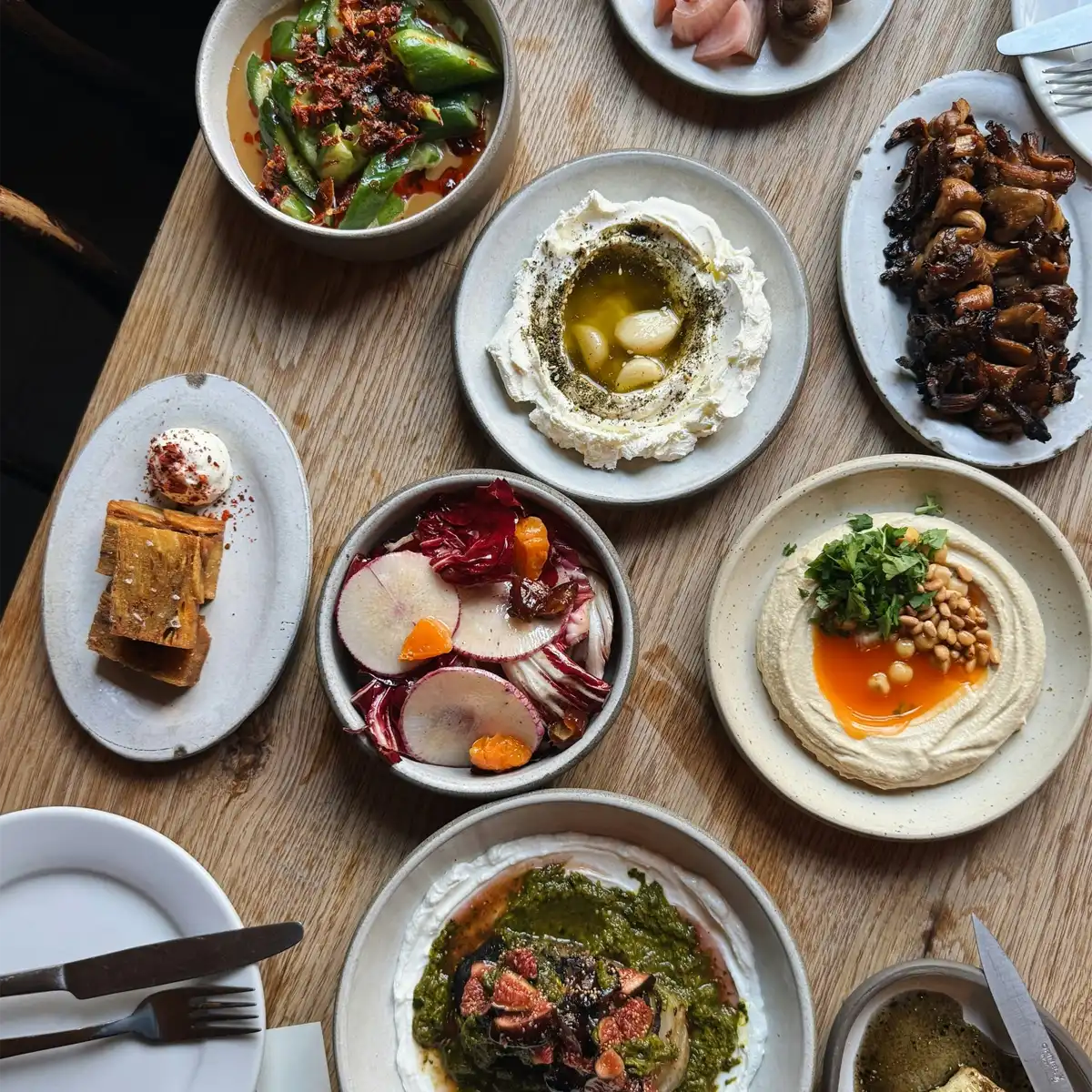
A typical progression of the Bubala Knows Best dinner gives a sense of the approach. Bowls of glossy hummus might arrive first, ringed with excellent olive oil and accompanied by soft laffa bread that tears into perfect dipping strips. Smacked cucumbers, dressed with tahini, chilli crunch and sharp pickling juices, bring a bracing snap of acidity. Halloumi arrives streaked with grill marks, draped in black seed honey that runs salty, sweet and gently bitter all at once. Oyster mushrooms, marinated in tamari and coriander seed, are grilled until their edges crisp and their centres stay juicy, carrying a savoury depth that feels closer to barbecued meat than to a plate of "vegetables".
The result is a form of culinary lightness that is texturally robust and psychologically satisfying. There is smoke, fat and richness. There is umami in abundance from ferments, char and long-cooked alliums. What is missing is the heavy post-prandial slump that often follows a steakhouse blowout. In Soho, where lunch guests tend to head back to edit suites and offices and evening guests may be on their way to shows, that matters. Bubala's menu is built to energise rather than sedate.
Acidity is used as a decisive tool. Almost every rich element has a counterpoint: labneh pairs with amba or pickles, oily sauces are cut with citrus and vinegar, confit potatoes meet sharp sauces and herbs. The effect is cumulative. By the end of a long sequence of small plates, diners are replete but rarely weighed down. It is the sort of meal after which a second bottle of wine feels plausible rather than reckless.
Fun fact: In Yiddish, "bubala" is a term of endearment often translated as darling or sweetheart
Designing A Restaurant Around Light
The notion of light at Bubala is not just metaphorical. It is embedded in the room's physical design, which was created with the interior architecture studio Other Side. Rather than the industrial cliches that dominated London restaurant design for years, Bubala opts for rough plaster walls, warm timber and simple, clean lines.
Those plaster walls are not just a visual statement. The textured surface helps to scatter sound waves, softening what could easily become a clattering echo chamber given the hard floors, open kitchen and dense seating. They also give the light somewhere to land. Instead of bouncing harshly off flat paint, the glow breaks into a gradient of shadows, creating a more nuanced, flattering environment.
The lighting system itself uses warm-dim technology. At lunch, the room operates at a slightly cooler, brighter tone around 2700K to 3000K, keeping things brisk and functional enough for a one-hour business lunch. As evening service begins, the levels are lowered and the temperature warms, moving towards that 2400K sweet spot. The effect is subtly biological. Warmer light supports relaxation and encourages guests to settle in, linger, and, yes, order another drink.
For a Soho restaurant with an open kitchen, light is also a tool of focus. Ambient illumination comes from wall washes and a prominent ring feature overhead, while pendants or more targeted lighting draw the eye to plates and to the chefs working the grills at the back. Even when the room is packed, there is a sense that the stage is the pass, and that the performance is the calm choreography of the line.
Why Soho Is The Toughest Test For Bubala
Bubala's expansion from its original Spitalfields site into Soho was always going to be a test of concept. Spitalfields, with its younger, creative crowd and relatively forgiving rents, is naturally sympathetic to a meat-free, vegetable-forward restaurant. Soho is different. It is among the most competitive hospitality real estate in the country.
The address, 15 Poland Street, carries history. For more than half a century, it housed Vasco & Piero's Pavilion. This beloved Italian institution quietly fed generations of regulars while the neighbourhood changed around it. The handover from a family-run pasta house to a modern, Middle Eastern vegetarian venue could easily have prompted local scepticism. Bubala has had to persuade Soho regulars that it has the staying power and seriousness to justify replacing a piece of the district's memory.
The building itself adds pressure. This is a deep, narrow townhouse with limited frontage and a finite footprint. High W1 rents and business rates make it essential that almost every square metre earns its keep. The 50 or so covers are packed in relatively tightly, and the open kitchen does double duty as both a service engine and a visual feature. There is little spare square footage for waiting areas or glamorous circulation space. Storage and staff stations are tucked into corners and under counters with Tetris-like precision.
Soho's regulatory environment adds another layer. Bubala operates within the West End Stress Area, where late licences and new operations are heavily scrutinised by the council. Running a charcoal grill in a mixed-use block requires powerful extraction to remove smoke and odours before they can drift into residential flats above. Planning records for the street make clear how sensitive neighbours can be to noise, particularly low-frequency sounds that travel through Victorian brickwork. Bubala's investment in acoustic isolation, including floating floors and decoupled ceilings, is part of the cost of doing business as a busy restaurant in Soho rather than optional polish.
Produce, Wine And The Supply Chain Of Lightness
If your entire menu is built around vegetables, the supply chain becomes existential. Bubala relies on premium suppliers such as All Greens, which work with many of London's top kitchens. Executive chef Ben Rand's relationship with those suppliers is central to how the menu evolves. When a particular variety of squash or brassica drops out of season or availability, dishes have to rotate quickly.
This demands a nimble, technically capable kitchen team. Vegetables served days after picking lose texture and sweetness, so Bubala runs on a near just-in-time delivery rhythm to keep produce at its peak. Oyster mushrooms are chosen not simply because they are fashionable but because their density and water content allow them to take a fierce grilling without collapsing into mush. Halloumi is paired with a specific black seed honey with the right viscosity and floral profile to bridge salty cheese, smoke and spice.
The drinks list is built along complementary lines. Curated by Beattie & Roberts, the wine programme leans towards small producers, organic farming and low-intervention styles. Skin-contact "orange" wines, refreshing pet-nats and bright, high-acid whites from regions such as the Loire sit comfortably beside plates loaded with garlic, citrus, chilli and fermented sauces. Heavy oak and muscular tannins rarely work with Zhoug, harissa or amba; juicy, textural natural wines often do.
Crucially, pricing remains relatively accessible by central London standards. Bottles in the £30 to £40 range give younger drinkers or cautious corporate bookers options that feel indulgent but not punitive. By pairing natural wine in Soho with a plant-led menu, Bubala positions itself for customers who might previously have split their time between small-plates wine bars and more conventional restaurants, rather than finding both under one roof.
Service Rhythms And Life In The Open Kitchen
At Bubala Soho, the kitchen is not tucked away; it is the axis around which the room turns. Grill smoke, flashes of flame and a constant dance of plating are part of the show. That visibility brings pressure. Chefs must maintain a state of performative calm, even when tickets stack up, and the Charcoal section is working at full tilt. Any flare-up in temper would be visible to half the dining room.
Operationally, the menu structure is designed to keep that pressure within manageable bounds. The Bubala Knows Best set (£46 per person at dinner) channels a large proportion of tables into a pre-planned progression. At lunch, a £33 mezze format targets a 60-minute dwell time for the local creative workforce, who need something more interesting than a sandwich but cannot disappear for an entire afternoon.
For the kitchen, this means mise en place can be prepared in significant volume, and dishes can be fired in waves rather than in completely bespoke sequences. For the front of house, it allows a clear pacing pattern. A typical evening table turn runs from 90 to 120 minutes, brisk by traditional three-course standards but normal for a modern small-plates restaurant in central London.
Culture behind the scenes matters in a room this intense. Bubala's leadership is vocal about staff welfare and retention, including a peer-to-peer rewards system called "Happy Cheques" that allows team members to recognise one another's efforts with bonus payments. In a city where experienced hospitality staff are increasingly hard to hire and harder still to keep, that kind of internal recognition is not just good PR; it is a defensive strategy.
Who Eats At Bubala And When
Poland Street sits at a crossroads between Oxford Circus shopping and Soho's dense concentration of media offices, members' clubs and bars. Bubala's guest profile reflects that geography across the day and week.
At lunch, the room attracts a professional crowd. Pairs and trios of producers, editors, designers and marketing leads slide into tables for a compressed but sociable hour. They are looking for food that feels thoughtful enough for a client or colleague meeting but that will not derail the afternoon's work. Laptops are gently discouraged, but notebooks and production schedules appear on tables between plates.
Evenings bring a different mix. As the light shifts to warmer tones and the music nudges up, the dining room fills with couples from across London, small groups marking birthdays and anniversaries, and dedicated food lovers working their way through lists of the best restaurants in Soho. The open kitchen counter becomes prime seating for solo diners or pairs intent on watching the line at work.
The building's constraints shape experience at the margins. There is a single unisex bathroom that can become a social bottleneck on busy evenings. Narrow aisles require some choreography between staff and guests. The density of the seating plan means neighbouring conversations are close enough to overhear, which some visitors view as part of Soho's charm and others experience as an intrusion.
Where The Experience Struggles
No restaurant in central Soho can entirely avoid friction points, and Bubala is no exception. The most frequently cited issue in online reviews is noise. The same acoustic insulation that protects residents in the flats above from thudding bass and late-night laughter also traps the dining room's energy. When Bubala is full, particularly on weekend nights, the sound levels can soar. For younger diners, this reads as buzz; for older guests or anyone with hearing sensitivities, it may feel punishing.
Space is the second recurring pressure. Plates arrive in quick succession under the set menu format and two-person tables can quickly vanish under bowls, sharing dishes, bread baskets, glasses and bottles. When the front-of-house team are on their game, plates are whisked away almost the instant they are emptied, preserving enough breathing room to enjoy the sequence. When the rhythm stutters, the clutter can begin to undermine the otherwise carefully considered sense of ease.
Value perception is the more nuanced challenge. For some diners, paying north of £120 for two, including drinks and service, for a meal built around vegetables and dairy still feels like a psychological hurdle, however complex the preparations. Bubala's counterargument is that guests are paying for labour, sourcing and technique rather than for a particular cut of animal protein. In an era of rising costs, that justification must be made silently on the plate with every visit. For many, the combination of flavour, atmosphere and narrative does the job. Others may still leave wondering whether a comparable spend on a more traditional format might have delivered more obvious material luxury.
From Soho To Kings Cross And Beyond
Bubala is no longer a single clever idea in an East London site. The opening of a larger restaurant in King's Cross in April 2025, complete with a wood-fired oven and terrace, suggests that the brand's "lightness" philosophy can be scaled into larger, more commercial shells. That site offers a range of cooking techniques, with baking and slower roasting joining the repertoire of grills and open flames that define Soho.
Within London's broader dining landscape, Bubala sits alongside places like Rovi and Tendril in redefining what plant-based restaurants in London can look and feel like. These are not ascetic spaces reserved for the most virtuous diners. They are loud, design-conscious, wine-driven and built for celebrations as much as for weekday suppers. In that context, Bubala's presence in one of the city's most visible hospitality districts carries symbolic weight. A restaurant that serves no meat and no fish can now compete head-on for prime West End footfall.
Verdict On Bubala Soho
As the last plates are cleared and the kitchen stoves die back to embers, Bubala Soho's particular magic becomes easier to read. The combination of carefully tuned light, purposeful sound, close-quarters design and assertive cooking works towards a single outcome: guests leave feeling energised rather than weighed down.
It is not a restaurant for everyone. Those who crave hushed rooms and white tablecloth formality will struggle with the volume and density. Diners who equate value strictly with animal protein may bristle at the bill. Yet for anyone looking for a modern Middle Eastern restaurant in Soho, for groups of friends seeking somewhere where vegetarians and omnivores can eat with equal enthusiasm, or for couples who want their date night to feel convivial rather than solemn, Bubala makes a compelling case.
Practical details reinforce that message. Allow around £60 to £80 per head for the set dinner with wine, depending on how enthusiastically you order from the drinks list. Book ahead for weekend evenings and be prepared to sit close to your neighbours. If you are noise-sensitive, an earlier midweek slot might suit you better than a late Saturday service.
Push through the heavy door back onto Poland Street, and the contrast snaps into focus. The light is colder, the air sharper, the traffic louder. For a few hours inside number 15, though, Bubala offers a different register: a glow that flatters, food that hits hard without flattening you, and a sense that vegetable-led dining belongs firmly in the centre of London's going-out map.
More in the Soho restaurants guide
Part of our Soho restaurants guide.