Horse racing forms can be overwhelming at first with all the numbers, abbreviations, and statistics. For a beginner, it might be hard to comprehend how professional punters understand all of it.
However, the reality is that once you grasp the fundamental concepts, form reading becomes easier and much more enjoyable. By the end of this guide, you will be able to utilize form to help make better betting decisions seamlessly.
What Is Horse Racing Form?
To put it simply, “form” is the record of a horse’s recent performances. It indicates how the horse has run in previous matches and highlights how it is likely to run in the coming matches.
A Simple Definition
When betting on horse racing, it is essential to understand the racing form. The form is a document that includes a horse’s history and performance. It records the respective positions, surface conditions, distances, and, at times, the jockeys and trainers. In short, it is the resume of the horse in racing.
Where You’ll See Form
- Race Cards at Tracks: Printed documents that detail the information of every horse, including statistics and a history of the past few races.
- Online Wagering Platforms and Sportsbooks: Documents that, in addition to statistics, provide more in-depth data, including rivalries and trainer information.
- Virtual or Online Casino Horse Racing: In this case, the form is computer-generated to offer the participants the sensation of actual wagering, albeit the horses themselves are fictitious.
How to Read Horse Racing Form — Step by Step
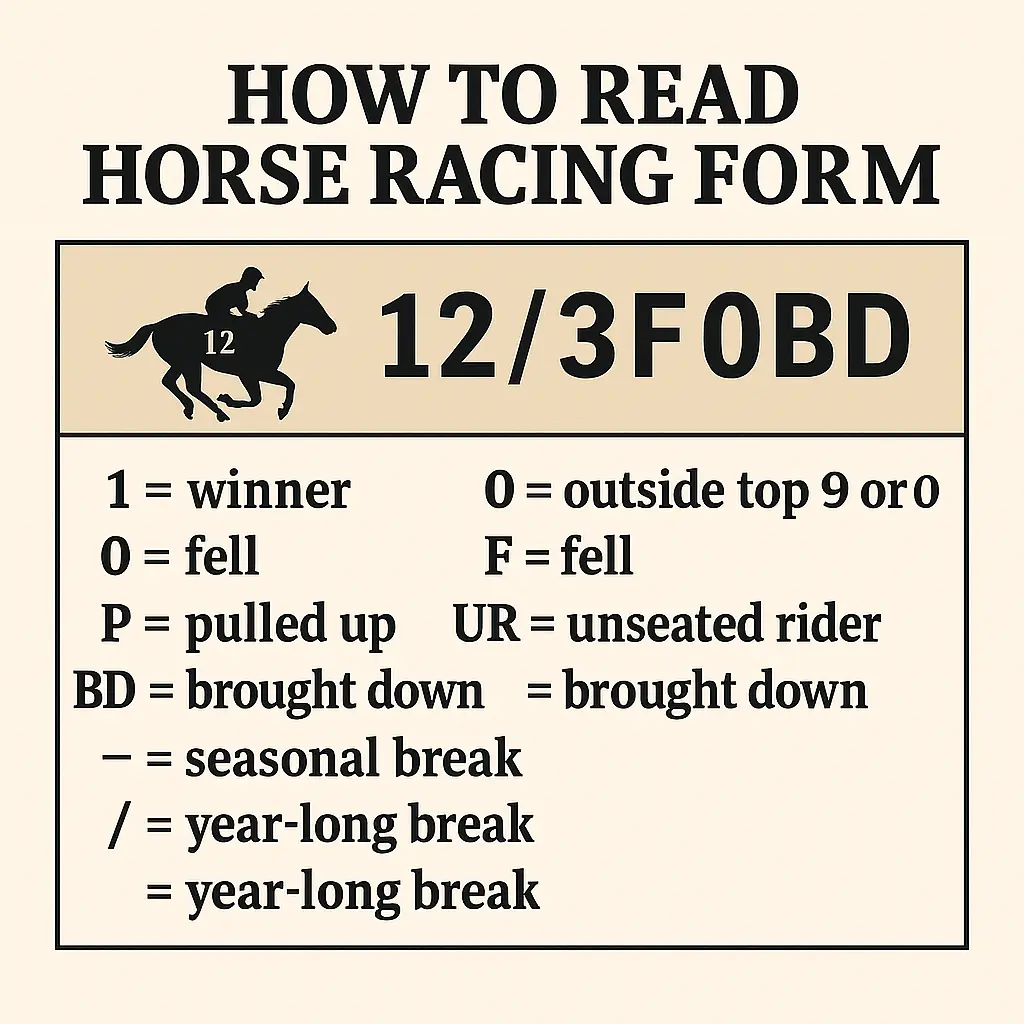
Understanding horse racing form is easy once you grasp the meaning behind each character or digit symbol. Let’s take a look:
Understanding Numbers and Placings
Numbers in the form line are just finishing positions:
- 1 = First place (winner)
- 2 = Second place
- 3, 4, 5… = Third, fourth, fifth, etc.
- 0 = Finished well down the field (usually outside the top 9 or 10 — this can vary by country/website)
- Higher numbers = lower finishing positions (e.g., 12 = finished 12th)
Recognizing Letters and Symbols
Letters and small symbols tell you incidents or breaks:
- P = Pulled up (jockey stopped the horse during the race)
- F = Fell
- UR = Unseated rider (the jockey came off)
- BD = Brought down (fell because another horse fell)
- – (dash) = Seasonal break (short gap between campaigns)
- / (slash) = Year-long or long break (longer absence, often a year)
Order of the Form Line
Different sources show the runs in different directions, so watch the order:
- Most racecards show the most recent run on the left and older runs to the right:
Example (most recent → older): 1 — 3 — P — 0 — / — 4
Breakdown (left → right):- 1 = won the most recent race
- 3 = finished third in the race before that
- P = was pulled up before that
- 0 = was unplaced earlier
- / = then a long (year) break
- 4 = finished fourth in the race before the break
- Some sources show the most recent run on the right (older → most recent). If you see that layout, read the line from right to left instead.
Key Elements Beyond Form Numbers
There are indicators that might be displayed along with form lines that can be crucial for evaluating chances.
Weight and Handicap Ratings
Every horse in a race, irrespective of the division, is linked to a certain weight along with the jockey. In handicap races, stronger horses are allotted more weight to help them. Even a few pounds here and there with the finish line in sight can tilt the race.
Jockey and Trainer Stats
Sometimes horse type, along with the jockey, and the strike rate. The jockey can act with the necessary acumen, and the trainer can optimally prep the horse on the necessary information given to them.
Track Conditions (Going)
The word “going” is used to indicate the state of the ground on the day of the race. Track Conditions are important for the race day, and this includes the rain or thawing of snow. Terms or conditions for this are:
- Firm: The surface that supports speedy horses since it is hard ground.
- Good: The surface on which most horses can perform because it is balanced.
Distances and Race Types
Not all horses are built for the same kinds of races.
- Sprints (short distances): Horse’s bases and speed starters are primary
- Middle (long distances): Horses that have stamina and require strong finishing power
Pro Tips for Reading Horse Racing Form Like a Pro
People assume that reading horse racing form is simply number crunching. This is far from the truth. It is about knowing what information to hone in on. While beginners are often overwhelmed by the amount of information present, professionals know areas that unlock the horse’s running potential.
Look at Recent Runs More Than Older Ones
A horse that recently placed in several races may be in better shape than a horse that won over a year ago. Consider the horse's most recent 3 to 5 races to get the most accurate assessment.
Spot Consistency vs. One-Off Wins
A horse race with only one recorded win is backed by the belief that there is an overwhelming chance that the horse will win again. Such assertions are often misguided. What matters in this instance is the reliability and steady performance that is shown by the horse finishing in 2nd or 3rd position more often.
Compare Horses in the Same Race
Form is most beneficial by comparing horses that are racing against each other. If Horse A defeats Horse B every other race that has the same track conditions or distances, that should ring a bell.
Don’t Ignore Layoffs and Breaks
A horse that hasn’t run in months might be fit and ready to race or unfit and slow to start. Trainers with a track record for having horses that don’t race for considerable periods of time in good condition are worth paying attention to. Always time the gap since the last race and weigh this against the trainer’s style.
Cross-Reference With Odds (and Overround if relevant)
Odds are a reflection of the horse’s worth according to market betting. If you can pick a horse with good recent form that has higher odds, it is a value bet. Just remember the bookies' overround, or their profit margin, that skews the market percentages over a hundred.
Common Mistakes Beginners Make
Even with the basics of form reading, it’s easy to slip into habits that lead to poor betting decisions. Here are some of the most common mistakes new punters should watch out for:
1. Thinking a Single Win Means Strong Form
A horse with a ‘recent’ win does not imply that the horse is in top form. Look for patterns instead. It is better to look for repeated consistent finishes near the top than for one victory that was due to luck.
2. Ignoring Breaks in Racing Seasons
Performance is affected by gaps, as the horse requires time to rejuvenate. Beginners tend to forget the performance implications of a break. Always pay attention to the last time the horse ran in a race.
3. Not Checking Track Conditions
A horse that is capable of running well on dry, firm ground is not able to do so on wet or muddy tracks. Conditions of the track should not be neglected when doing a form guide, as they can alter the result of the race.
4. Misreading 0s and Letters
Some new users may be bewildered by some symbols on the form guide. For example, the letter “0” on the guide does not imply that a horse didn’t finish; it implies that the horse finished outside the top 9 or top 10, depending on the format.
Example – Reading a Real Horse Racing Form Line
Let’s discuss the symbols with the help of examples.
Mock line: 45231
Read this left → right as older → newer, so the rightmost digit (1) is the most recent race.
| Race (old → new) | Result shown | Plain English |
| 1 (oldest) | 4 | Finished 4th |
| 2 | 5 | Finished 5th |
| 3 | 2 | Finished 2nd |
| 4 | 3 | Finished 3rd |
| 5 (most recent) | 1 | Won last time out |
What this tells you: This horse has run 5 races, in which it has won the last race. This horse has shown continuous improvement in all races won, which many punters consider to be a positive trend. In addition, you should consider the changes in distance, the class, and the surface.
Mock complex line: 3F21-0P
Break it into pieces. The hyphen (-) separates seasons or a big gap; everything to the left is older than everything to the right. Read left → right as oldest → newest.
Step-by-step:
- 3 → Finished 3rd (an older race).
- F → Fell in the next run (fell during the race).
- 2 → Came 2nd in the following race.
- 1 → Won that race (last run before the season break).
- - → Season break / separates last season from current season.
- 0 → Finished outside the first 9 (or 10 depending on the card’s rules) in the first race back this season.
- P → Pulled up (jockey stopped the horse before the finish) — this is the most recent run.
Symbols quick key (common meanings):
| Symbol | Typical meaning |
| 1–9 | Finishing position (1 = first, 2 = second, etc.) |
| 0 | Finished outside the first 9 (or 10) — check the card legend. |
| - | Separates seasons or large gaps in the form. |
| F | Fell. |
| P or PU | Pulled up (did not finish). |
| UR | Unseated rider. |
(Inexact letters and what counts as a 0 can differ from one publication to another; refer to the racecard’s description.)
How Online and Virtual Horse Racing Form Differs
Every type of racing form is not the same. When placing bets with a sportsbook, the form used is from real races along with real outcomes. However, in an online casino virtual racing game, the form is completely imaginary and does not correspond with real-world activities.
Real Racing (Sportsbooks)
When placing bets on live horse races, the context of the form is derived from horse performance data. The numbers and letters represent the horse's actual performance in preceding events, which is a reliable resource for betting strategies. It is possible to analyze trends, horses, and overall track conditions.
Virtual Racing (Online Casino RNG)
Here, outcomes are powered by Random Number Generators (RNGs). The “form” looks real but doesn’t influence results; it’s just there for realism. Strategy won’t help because results are random.
FAQs on Reading Horse Racing Form
What does “0” mean in horse racing form?
A "0" indicates the horse finished behind in a certain position of 9th or 10th, depending on the race card format.
Why are there letters like P or F instead of numbers?
Letters show special race events: P = Pulled Up, F = Fell, UR = Unseated Rider.
Do bookmakers use form to set odds?
Yes, but alongside trainer stats, track conditions, and betting patterns. Odds also reflect where the betting money goes.
Can beginners rely on form alone to pick winners?
No. Form is helpful, but you should also consider odds, track conditions, jockeys, and distance.
Final Thoughts
The horse racing form may appear daunting; however, if one knows how to interpret them, they serve as a significant aid to understand trends and improve wager choices. However, one should keep in mind that form is only part of the larger puzzle, and it must be integrated with the odds, track conditions, and jockey information for the best outcomes. Now, put your knowledge to the test by checking today’s race card and practicing how to read the form like a pro.