The choice between an independent specialist jeweller and a high street chain is not a choice about prestige. It is a choice about what you are actually buying with the money. Two rings can carry the same carat weight, the same colour grade, the same clarity grade, and the same laboratory report, and cost meaningfully different amounts. Buyers assume the gap is snobbery. It is not. It is structure.
Smith & Green have worked out of 9 Hatton Garden, EC1N 8AH since Chris Smith and Josh Green started the business in 2011, a 4-minute walk from Chancery Lane station. The showroom sits directly above the kind of bench work that makes the rings it sells. That arrangement is the entire argument, and most of what follows is an explanation of why it changes the economics of your purchase rather than just the atmosphere of it.
This article compares the two routes on the axes that genuinely differ. Stone selection. Pricing structure. Certification handling. Aftercare. And it says plainly who the high street suits better, because for some buyers it does.
What separates an independent specialist jeweller from a high street chain
An independent specialist jeweller sources loose stones individually and builds the ring around your chosen stone, usually in an in-house or local workshop. A high street chain buys finished rings in volume from manufacturers and sells from held stock. The first model gives you selection and control. The second gives you speed and standardisation.
Everything downstream follows from that one difference. Once a chain has committed to holding a finished ring, the stone in it was chosen by a buying department against a price point, not by you against a tray. The ring exists before you do. Your job in that model is to find the closest match among rings that already exist, which is a genuinely different task from specifying the ring you want.
The specialist model inverts it. Nothing exists yet. You choose the stone from loose material, you choose the setting, and the two get married in a workshop afterwards. Slower. More decisions. Considerably more control.
Where the money actually goes in each model
Volume retail carries costs that bespoke does not, and those costs are in the ring.
A national chain funds retail space in high-rent shopping centres, regional and national marketing, layered management, and stock that sits unsold for months while capital is tied up in it. None of that is waste. It is the cost of being findable in 200 towns and having a ring in a box the same afternoon. But it is paid for by the rings that do sell, which means it is paid for by you.
A specialist jeweller in EC1N funds a showroom, a bench, and the people at both. Stock risk is lower because most pieces are made against a confirmed commission rather than a forecast. Marketing is narrower. The overhead per ring is simply a different shape.
What this does not mean is that specialists are automatically cheaper. Some are not. A specialist selling you a finer stone at a fairer margin can still produce a higher invoice than a chain selling you a weaker stone at a bigger one, and the honest way to compare is not by headline price but by specification against price. Two quotes are only comparable when the stones behind them are comparable.
Why stone selection is the real difference
Selection is where the specialist route earns its case, and it is the part buyers underrate most before they experience it.
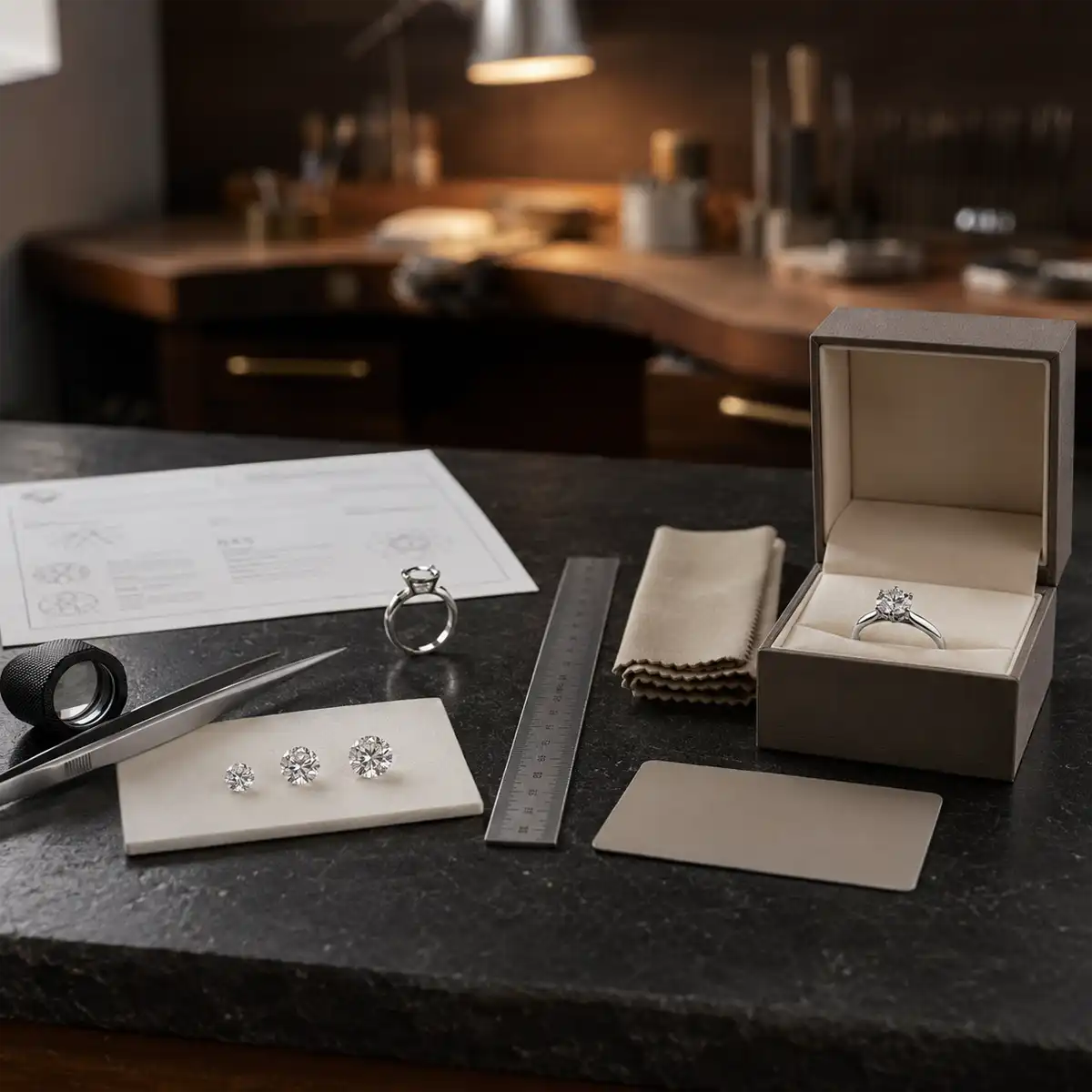
Put 4 diamonds of identical grade on a white pad in natural light. They will not look identical. Cut grade captures a great deal, but it does not capture everything about how a specific stone handles light, and 2 stones graded Excellent by GIA can perform visibly differently on the hand. The only way to exploit that is to look at several and pick. A model built on held stock cannot offer you that, because the stone arrived already set.
Certification is the second half of this. Every stone Smith & Green work with carries a report from a recognised laboratory, GIA or IGI, and the report is shown alongside the stone rather than produced afterwards as reassurance. That sequence matters more than it sounds. A certificate handed over at the point of payment is a receipt. A certificate handed over next to the loupe is a tool.
The lab-grown question sharpens all of this. Lab-grown diamonds are real diamonds, graded by the same laboratories against the same criteria, with origin stated on the report. They have also fallen sharply in price relative to natural stones, which means the same budget now buys dramatically different outcomes depending on which route you take. A specialist can put both in front of you and let you decide with the stones in view. A chain can only sell you what its buying department chose to stock, and that choice was made against margin considerations you will never see.
Fun fact: Hatton Garden takes its name from Sir Christopher Hatton, Lord Chancellor to Elizabeth I, who was granted the land in 1581, meaning the street has carried the same name for over 440 years and has been London's centre of the jewellery trade for roughly the last 200 of them.

What happens after you buy
Aftercare is where the two models diverge most sharply, and almost nobody asks about it before signing.
A ring worn daily needs attention. Claw tips thin. White gold loses its rhodium and dulls. Stones work loose in settings long before they fall out, and the window between "slightly loose" and "gone" is the entire value of an annual check. Smith & Green include complimentary polishing and cleaning, a full lifetime warranty, and yearly inspections in which the settings are checked and the stones confirmed secure. That is offered because the people doing it are 1 floor from where the ring was made.
Chain aftercare is a logistics operation. The ring goes away to a central facility, and the person handing it over the counter is not the person who will touch it. That is not incompetence. It is distance. The practical consequence is that small problems get caught later, and later is expensive.
Ask both routes the same question before you buy. Who will service this ring in 8 years, where will it physically go, and what does it cost. The answers separate the two models faster than any conversation about diamonds.
Who the high street genuinely suits
Some buyers should walk into a chain, and pretending otherwise would be dishonest.
If the proposal is in 10 days, the specialist route may simply not be available to you. Bespoke commissions run 6 to 10 weeks from approved design to finished ring, and no workshop worth commissioning will promise around that. A chain has finished rings on a shelf and can size one in a fortnight. Deadline beats philosophy.
If you find a ring you love in a chain window, that settles it. Nobody should talk themselves out of the ring they want on structural grounds.
And if choice itself is the problem, the chain model is a feature. Some buyers do not want a tray of loose stones and 6 setting decisions. They want 20 rings, one of which is right, and a decision made in an afternoon. That is a legitimate way to buy jewellery and the anxiety it removes is real.
How to test either route in 20 minutes
Judge both by the same 4 questions rather than by the room they are asked in.
Ask to see the laboratory report next to the loose stone, before it is set. If the answer is that the stone is already mounted and the certificate is in the back, you now know which model you are in.
Ask what the setting recommendation would change to if the ring were worn by someone who never removes it. A structural answer about claw height and metal choice indicates someone thinking about the object. A reassurance indicates someone thinking about the sale.
Ask where the ring is serviced, by whom, and what it costs. Then ask for the specification in writing, itemised, so it can be compared like for like against anything else you are holding. Any route that resists that last request has told you something important.
Pricing at Smith & Green is provided on consultation because it is specific to the stone and the labour, and a number quoted before either is known is a number invented for the comfort of quoting one.
Conclusion
Book the specialist appointment first, even if you expect to buy elsewhere, because it costs nothing and it recalibrates everything you look at afterwards. Smith & Green take appointments Tuesday to Saturday, 09.30 to 18.00, at 9 Hatton Garden, a short walk from Chancery Lane or the Farringdon Elizabeth line exit.
Ask to see loose stones before any are set. Ask who services the ring in 8 years and where it goes. Ask for the specification in writing, itemised.
On timing, work backwards rather than forwards. Under 6 weeks to a fixed date and the chain route may be the only honest option available to you. Over 10 weeks and an independent specialist jeweller can build you something that does not exist yet, around a stone you chose yourself, and there is no version of the high street that offers that.