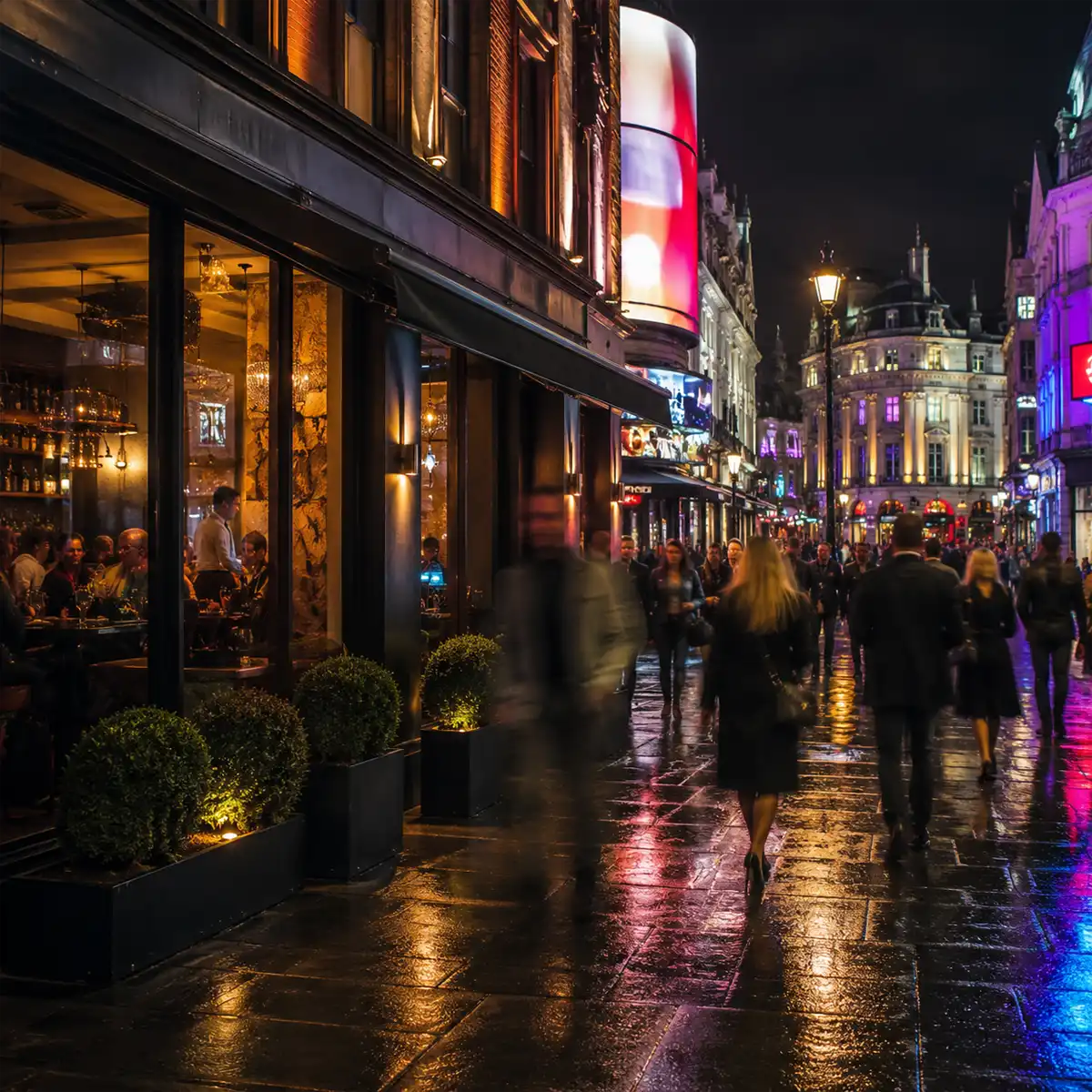
On a busy evening on Wardour Street, where production offices sit above neon-lit bars and queues snake outside Soho restaurants, Inamo looks like a natural extension of the district's fascination with spectacle. Inside, though, the main show is not a chef at a pass or a bartender working through a martini list. It is the table itself. Guests sit down to find an illuminated surface, tap to reveal menus, change their virtual tablecloth, summon a server, order drinks and launch games, all from the same projected interface.
Inamo opened in 2008, long before tablets on stands became commonplace in casual chains and before QR codes migrated from logistics to laminated menus. It pitched itself as a pioneer of interactive dining. In this place, software would flatten the friction of service while giving guests something to do between mouthfuls. More than 15 years later, the concept is no longer futuristic as it once was, but the restaurant still draws a steady flow of tourists, work groups, and families who want food that comes with a built-in talking point.
The address is prime. Inamo Soho sits at 134-136 Wardour Street, surrounded by household names like Princi and Yauatcha, and within a short walk of the West End's theatres and late-night bars. This is the media heartland, a neighbourhood reshaped from bohemian and sometimes seedy to polished and high-end, where experiential restaurants in Soho are judged not only on what is on the plate but also on whether they can earn their place in a crowded evening.
Inamo's proposition is straightforward: part restaurant, part digital entertainment venue, serving Pan Asian sharing plates, bottomless Asian tapas, and sushi deals, and giving you the sense that you are dining inside a gadget. The question for diners in 2025 is whether that trade-off still feels contemporary and good value, or whether the technology now lags behind the expectations of guests who already carry powerful screens in their pockets.
How The E Table Concept Works For Guests
The centre of the experience is Inamo's proprietary E Table system. Unlike the touchscreens in a fast-food kiosk, the tables are not glass. Overhead projectors beam a user interface directly onto a white tabletop, turning it into a canvas of menus, order buttons, virtual place settings and games. Sensors or cameras then track hand movements, so when you tap a projected button, the system registers your choice and sends the order to the kitchen.
On paper, it is an elegant way to give guests control. In practice, the limitations of projection technology are increasingly visible. There is no tactile feedback. Diners tap on wood or a matte finish rather than glass, which creates a slight disconnect between gesture and response. The system also appears less precise than a modern capacitive screen. Recent guests have reported having to prod icons more than once, or finding that the active touch zone does not quite line up with the projected graphic. Some mention lag, with orders, games or table settings taking a second or two to respond.
Ambient light is another constraint. To keep the projections legible, the room is deliberately kept dim. That supports the club-like atmosphere and flatters the graphics, but it can make it harder to see the actual food once it lands on the table, especially for diners with weaker eyesight. The effect is a digital theatre that sometimes asks you to choose between seeing the screen clearly and seeing your plate clearly.
The E Table is not just a menu. It functions as a console for eatertainment. Diners can launch multiplayer games such as Pong, Air Hockey or retro arcade shooters, sketch on the surface, flip through virtual tablecloth designs or watch the live kitchen feed known as Chef Cam. For families, particularly those with children old enough to play but not old enough to sit happily through a drawn-out meal, this can be transformative. Parents writing online often praise Inamo as one of the few family-friendly restaurants in Soho where a restless 8-year-old is as entertained as the adults.
That same layout can create social hierarchies at the table. Because only some seats sit within easy reach of the main control zones, larger groups tend to default to one or two people acting as "drivers", responsible for placing orders and controlling the games, while others become passengers who must ask for what they want. It is not always a problem, but it does undercut the sales pitch of total agency.
Technology Fees, Friction And Perceived Value
One of the most unusual aspects of Inamo's model is the explicit pricing of its technology. Alongside food, drink and the standard 12.5% service charge, guests are billed a per-person "Tech License" fee, typically in the region of £2.50, framed as a contribution towards maintaining and improving the interactive system and, in theory, helping keep service charges lower.
In a city where restaurants routinely spend heavily on design, lighting and sound systems without line-iteming those costs, this separate fee is striking. In effect, diners are paying to rent the table's capabilities for the duration of their booking as well as paying for the meal itself.
When the system works smoothly, some guests accept the charge as part of the package. However, frustration escalates quickly when something misfires. Diners who find themselves ordering through waiting staff because their table is unresponsive, or who cannot access the games that were the main draw for their children, are likely to feel that they have subsidised a product that did not perform as advertised. In that scenario, the Tech License becomes a symbol of friction rather than a fair contribution to innovation.
The question of value runs deeper than a single fee. Inamo positions itself in the crowded market for bottomless brunch in Soho and fixed-price sharing menus. Its headline deals, such as Unlimited Asian Tapas & Sushi, tend to sit between £30 and £50 per head, depending on whether alcoholic drinks are included. On the face of it that looks generous for central London, but the structure of these offers is tightly controlled.
Time limits are strict. Bookings on unlimited packages usually run to a 90-minute slot, with last orders taken approximately 15 minutes before the end. The ordering system permits three dishes per person at a time, and further rounds are locked until roughly 75% of the previous plates have been eaten. Drinks often operate on a similar "bottomless but bounded" principle, with guests required to choose one type of drink for the duration, whether that is beer, wine or bubbles, rather than switching between them.
From the restaurant's perspective, this is an efficient way to keep waste in check and prevent over-consumption. It also smooths service in a compact dining room where the kitchen and bar have finite capacity. For diners, the experience can feel either smartly paced or slightly constraining, depending on how responsive the staff are in confirming that plates have been cleared and triggering the next round. The phrase "unlimited" here is best interpreted with an understanding of the rhythms of the system rather than as a literal free-for-all.
Fun fact: Inamo was one of the first London restaurants to let guests switch virtual tablecloth designs and watch a live kitchen feed from their seats.
Pan Asian Sharing Plates And What To Eat First
Strip away the graphics and timers, and Inamo is, at its core, a Pan-Asian restaurant in Soho that trades in familiar high-street favourites with a few premium touches. The menu draws on influences from Japanese, Chinese, Thai, and Korean cuisines. It presents most dishes as small plates designed for sharing, a format that suits both the technology and the bottomless model.
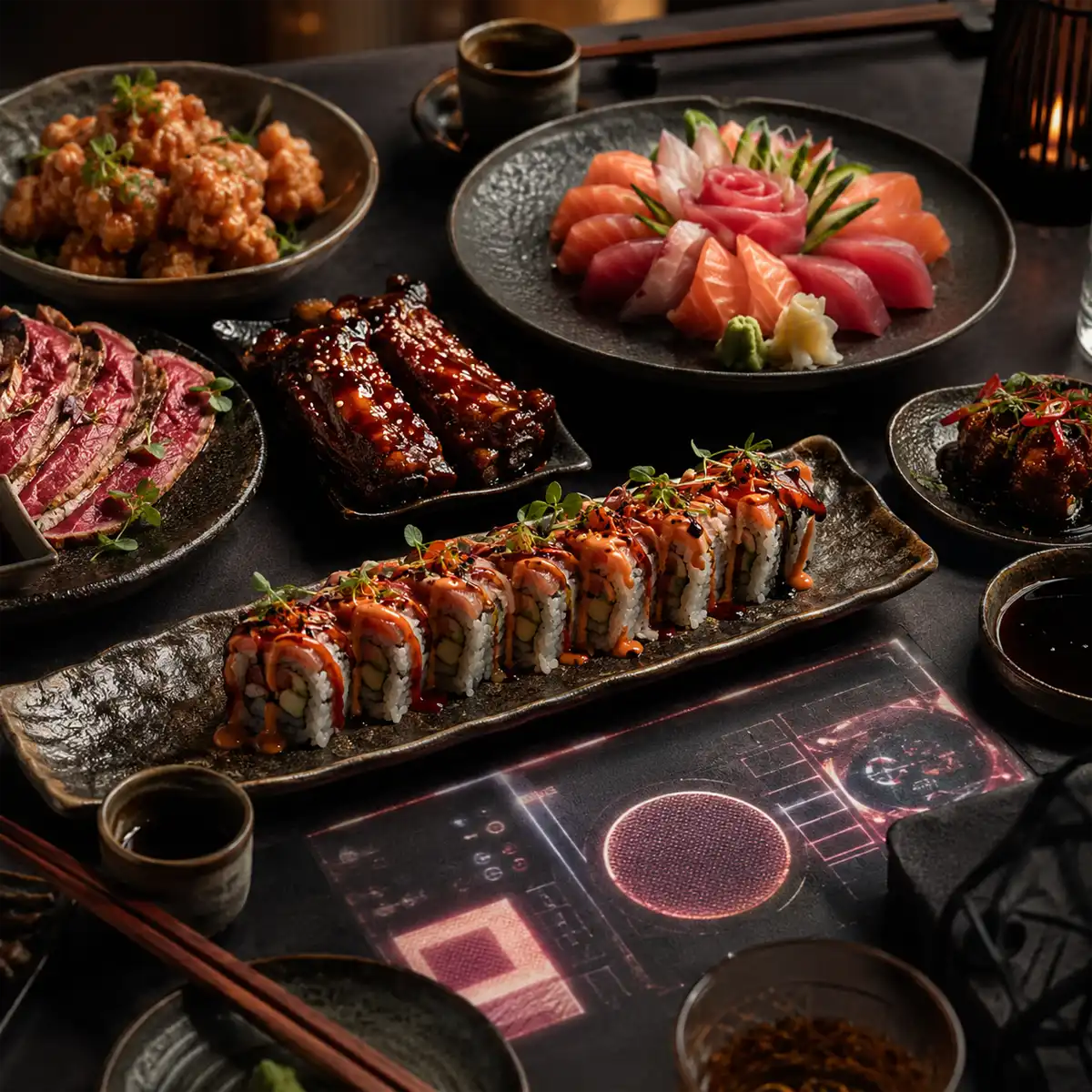
On the meat and seafood side, dishes such as Yuzu & XO Beef Fillet Tataki, Sichuan Chicken, Korean BBQ Ribs and Black Miso Pork Belly aim to bridge comfort food with a touch of restaurant polish. The tataki is one of the clear flagships. Beef fillet is seared briefly so that the exterior chars while the centre remains raw, then thinly sliced and dressed with two powerful flavour accents. XO sauce, a rich Hong Kong invention made from dried seafood, chilli and aromatics, brings an intense savoury heat, while yuzu, the Japanese citrus, cuts through with bright acidity. When executed well, it is the kind of plate that elevates the experience beyond generic chain territory.
Other plates lean more overtly into indulgence. Korean-style ribs arrive sticky and sweet, with an umami glaze designed for fingers more than chopsticks. Sichuan Chicken, if faithful to its inspiration, should deliver the numbing spice that fans of the region expect. A Hokkaido scallop ceviche, cross-referencing Japanese and Peruvian Nikkei traditions, reads as a statement that the kitchen is willing to handle both raw, premium ingredients and fried crowd-pleasers.
The sushi and sashimi list is compact but photogenic, calibrated for the Instagrammable restaurants in the Soho segment. Dragon Rolls, with tempura prawns and avocado wrapped in rice and topped with sauces, are as much about texture and presentation as they are about strict Japanese orthodoxy. The Sashimi Rose arranges slivers of fish as a flower, engineered as a camera-ready moment as much as a test of slicing skill.
Plant-based diners are notably well served. Inamo advertises more than 20 vegan and vegetarian dishes, and the list runs well beyond token salads. Bang Bang Cauliflower is a key example. The florets are battered or roasted until crisp, then coated in a creamy, spicy sauce built on sriracha and vegan mayonnaise, clearly aimed at those who might previously have ordered popcorn shrimp or wings. Vegan takes on sushi, such as the Red Dragon Roll or plant-based nigiri that mimic salmon using konjac or other substitutes, align the experience more closely with the main menu rather than relegating non-meat eaters to the sidelines.
As with many Asian tapas operations, the architecture of small plates nudges guests towards ordering more than they strictly need. The visual menu, which projects images of each dish directly onto the table surface, amplifies that effect. When you can see how a roll or skewer will look on your own place setting before you commit, it becomes harder to resist tapping "add to order" one more time.
Dietary Options Pricing Transparency And Risk
For diners with specific dietary needs, the picture at Inamo is mixed. On paper, the restaurant is strong on range. Vegan and vegetarian dishes are clearly labelled, and numerous items are described as suitable for those avoiding gluten. In marketing materials, the venue cites upward of 25 non-gluten options.
However, this breadth comes with a clear and unambiguous caveat. The kitchen handles nuts, gluten and other allergens throughout its operation, and the restaurant itself notes that any dish may contain traces of those ingredients. Soy sauce, tempura batters and shared fryers all increase the likelihood of cross-contamination.
For a Coeliac diner, that combination of shared equipment and explicit disclaimers makes Inamo a high-risk venue rather than an inclusive one. Those with intolerances or lifestyle-driven gluten avoidance will find plenty to choose from. Still, anyone with an autoimmune condition is likely to be better served by a restaurant that can guarantee segregated preparation areas and verified gluten-free protocols.
Halal status is even more opaque. The menu includes pork in several forms, from Black Miso Pork Belly to Char Siu. It uses sauces that traditionally contain alcohol, such as mirin or sake. There is no prominent certification from a Halal monitoring body, and no clear indication that the meat is sourced and handled in accordance with Halal standards. Observant Muslim diners who require strict compliance should therefore assume that Inamo Soho is not suitable, even if some individual ingredients might be acceptable.
When it comes to overall cost, the restaurant sits in the mid-market by West End standards, but guests should factor in the structural extras. The headline price of an unlimited sushi London deal does not include service, the Tech License fee or any side orders that fall outside the package. Soft drinks, cocktails and bottles of wine can quickly push a bill upwards in a part of town where margins are tight and demand is high.
Service Bookings Accessibility And Who Inamo Soho Suits
In theory, the E Table enables Inamo to redeploy staff from order-taking to food running and guest support. In reality, human service still plays a decisive role in how smoothly the night runs. Staff are needed to explain the interface to first-time visitors, check in on tables where the system has frozen, confirm when plate-clear thresholds have been met for another round on a bottomless booking and handle payment problems.
The structure of the deals is reflected in the booking policies. Many of the most aggressively priced offers must be pre-purchased as vouchers several hours in advance, effectively locking in revenue before the guest has set foot in the building. No-show or late cancellation policies are correspondingly strict. It is common for these vouchers to be forfeited entirely if a party fails to appear, and rescheduling windows can run to 48 or 72 hours, depending on the promotion. Functionally, this puts Inamo closer to a ticketed event than a casual walk-in restaurant in Soho, particularly for high-demand weekend slots.
Group size limitations are shaped both by licensing and by the hardware. At Soho, the interactive tables restrict how far furniture can be moved or combined without misaligning the projections. As a result, there are upper limits on how many guests can access unlimited packages in a single sitting, typically lower than at the larger Covent Garden sister site. For corporate organisers, that can mean splitting teams across multiple tables or even multiple sittings.
Accessibility is where Inamo Soho falls most sharply short. The building has steps at the entrance and a narrow, steep staircase leading to compact toilets on a lower level. There is no lift. For wheelchair users, the space is effectively off limits. Those with limited mobility may find the ascent and descent uncomfortable or unsafe. The company's solution is to direct guests who need step-free access to its Covent Garden branch, which is more modern and fully accessible.
Legally, this may satisfy the requirement for reasonable adjustment across an estate, but in practical terms it segregates the audience. Suppose you are planning a group meal where even one person uses a wheelchair or has significant mobility issues. In that case, Soho is not a viable option. That is a non-negotiable consideration for corporate dining in Soho, family gatherings and any celebration that needs to be inclusive.
In terms of atmosphere, noise levels are high. The combination of games, background music, animated projections and tightly packed tables produces a lively, sometimes frenetic environment. It suits birthdays, mixed-group nights out and first dates where built-in distractions can lift the pressure. It is much less suited to guests looking for a quiet, contemplative meal or a serious discussion over dinner.
Location, Neighbouring Venues And How To Get There
One of Inamo Soho's strongest assets is its connectivity. Wardour Street sits at the centre of several major transport hubs. Tottenham Court Road, now expanded by the Elizabeth line, is roughly a 3-minute walk away via the Dean Street exit and offers step-free access from street to train. Piccadilly Circus and Oxford Circus, each about 6 minutes on foot, link the restaurant to the Bakerloo, Piccadilly, Victoria and Central lines.
This makes Inamo a convenient anchor for a night that includes theatre, cinema or a bar crawl. It also means that guests arriving from Heathrow, east London or the suburbs can reach the venue with relatively few changes, an important consideration for larger groups or time-sensitive bookings.
The immediate neighbourhood is dense with food and drink options, which shapes how Inamo works in practice. For many, it functions as the first stop rather than the main event. The 90-minute cap on bottomless bookings and the energetic pacing mean that guests are often back on the pavement by 9pm, looking for a bar or dessert spot.
Within a short walk, Bar Swift on Old Compton Street offers a markedly different take on hospitality, with a focused cocktail list and calm, professional service upstairs and a darker, speakeasy-style room below. Cahoots in nearby Kingly Court leans into a transport-themed, 1940s pastiche that pairs well with Inamo's own enthusiasm for theatricality. At the other end of the spectrum, historic pubs like The French House or the Coach & Horses provide a snapshot of old Soho, all wood panelling and conversation rather than screens and projections.
For out-of-town visitors hunting for places to eat in Soho near theatres, Inamo has obvious appeal as a pre-show choice. It is close enough to walk to most of the major stages, fast enough that you are unlikely to miss curtain up, and lively enough to kick off an evening with a sense of occasion.
Final Verdict On Inamo Soho
Inamo Soho occupies an unusual niche in London's dining hierarchy. It is not trying to compete with purist sushi counters or high-end tasting menus on the quality of its cooking alone, and it does not pretend otherwise. Its core product is a hybrid of an interactive restaurant London concept and broadly accessible Pan Asian food, presented through a layer of technology that is now old enough to have its own design nostalgia.
The strengths are clear. Teenagers, tech-curious adults and families with school-age children are likely to enjoy the novelty of ordering from the table and playing games between courses. Corporate teams in need of an ice-breaker, or friendship groups celebrating birthdays and work milestones, will find that the structure of unlimited packages, time slots and set prices removes some of the social awkwardness of splitting bills and deciding how much to eat.
There are equally clear limitations. Accessibility at the Soho site is effectively non-existent for wheelchair users and difficult for anyone with mobility challenges, which makes it a non-starter for mixed-ability groups. Diners with Coeliac disease or strict Halal requirements will struggle to eat here with confidence, given the menu composition and allergen disclaimers. Guests looking for a quiet, romantic dinner, or an authoritative exploration of a single Asian cuisine, will find better fits elsewhere among the best restaurants in Soho.
The technology, once dazzling, now sits uneasily between innovation and maintenance burden. When it works, it still has charm and can create a sense of occasion that is hard to replicate at home. When it glitches, it foregrounds its age. It invites comparison with the frictionless, high-resolution interfaces embedded in the phones on every table.
Inamo Soho remains, then, a very particular kind of night out. Treat it as a digital playground that happens to serve food, choose it for the right company and occasion, and read the small print on time limits, fees and booking terms before you commit. For the right party, it will feel like a fast-paced, neon-lit game with plates of sushi and tapas dropped into the action. For others, especially those who come primarily for the cooking, it may feel more like an entertainment system in search of a restaurant.
Related reading: Nessa Soho Restaurant Sets A New Standard In Dining, Pre-theatre dinner in Soho by West End theatre 2026.