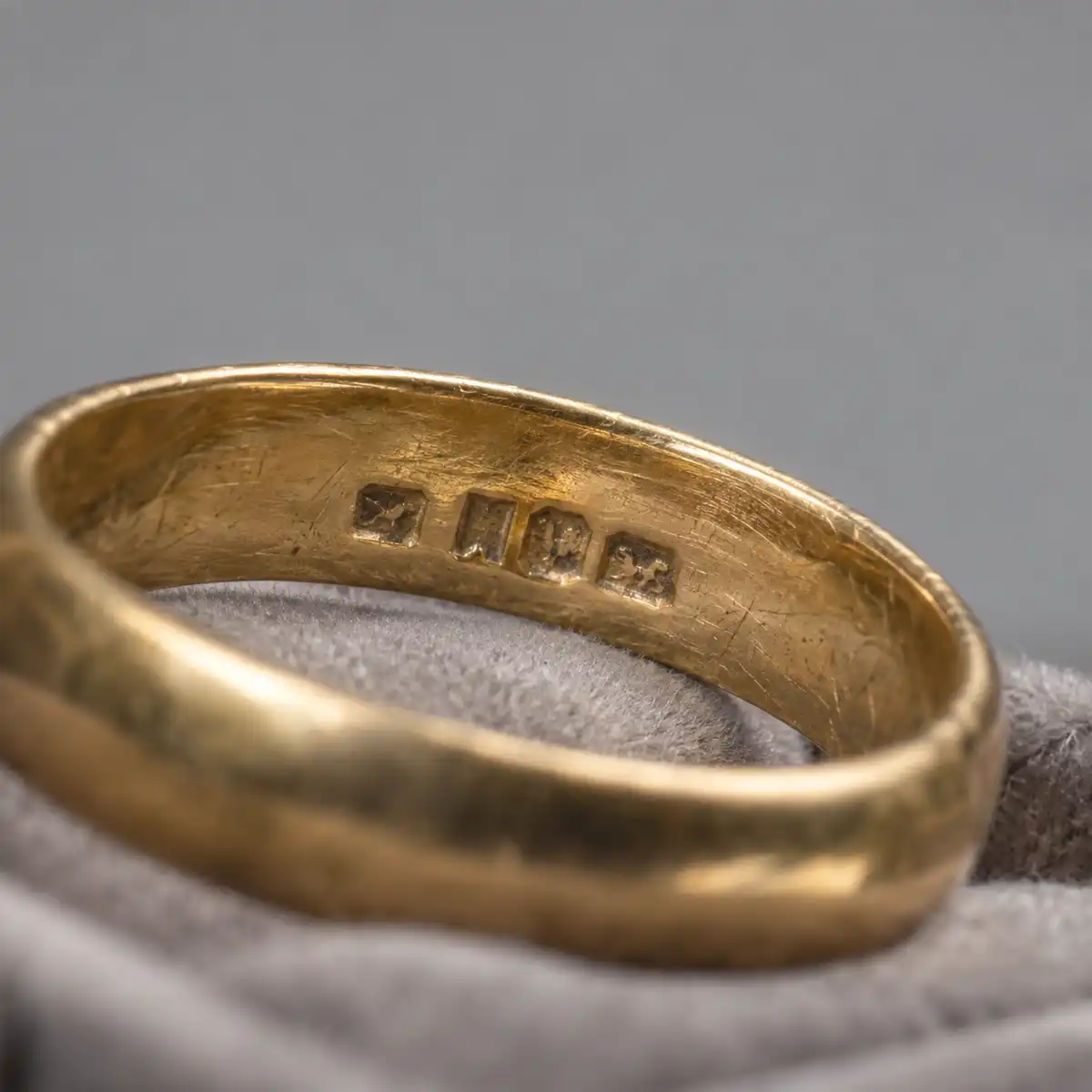
Under a loupe at a Hatton Garden counter, the inside of an 18ct band shows a short row of tiny stamps: two initials in a shield, the number 750 in an octagon, a leopard's head and a single letter. That row is the whole legal identity of the metal.
Smith & Green Jewellers is a fine jewellery retailer in Hatton Garden, London EC1N, specialising in bespoke engagement rings, diamond and coloured gemstone jewellery and handcrafted wedding bands, and gold hallmarks are read across its counter every working day.
The plain answer to what UK gold hallmarks certify is narrower than most buyers assume. A hallmark is an independent assay office's guarantee that the metal is at least the stated fineness, struck after testing, under the Hallmarking Act 1973. It says nothing about the stone, the plating, the maker's skill or the country where the ring was made.
The sections below read the marks in order, correct the most common misunderstanding about the 750 stamp, and explain what the Assay Office two streets away actually does with a ring.
The four stamps on an 18ct band read in order
Take the band as a type. An 18ct yellow gold wedding ring made for the UK market carries, from left to right, the sponsor's mark, the millesimal fineness number, the assay office mark and usually a date letter.
The sponsor's mark is at least two letters in a surround, registered with an assay office, and identifies the person or firm that accepted responsibility for submitting the piece. The trade often calls it a maker's mark, but a retailer, an importer or a commissioning designer can be the registered sponsor.
The fineness mark is the number. For gold the recognised standards include 375, 585, 750, 916 and 999 parts per thousand, which the trade still calls 9ct, 14ct, 18ct, 22ct and 24ct. The shape around the number identifies the metal: gold takes an octagon, silver an oval, platinum a house shape and palladium three joined ovals, so the surround is a clue even when the number is worn.
The assay office mark is the town mark. London uses the leopard's head, Birmingham the anchor, Sheffield the rose and Edinburgh the castle. The date letter, one character in a shield, changes every 1 January and has been voluntary since 1999, though the London Assay Office still applies it as standard unless asked not to. Widen from this one band and every piece carrying UK gold hallmarks follows the same grammar.
What gold hallmarks guarantee and what they do not
Gold hallmarks guarantee one thing: that an independent assay office tested the metal and found it not less than the stated fineness, marked to the lowest standard present in the piece. They do not certify the diamond, any rhodium plating, the origin of the gold, the date the ring was made, or that the ring was made in the city whose mark it carries.
The Act requires the mark on any article described or sold as gold above an exemption weight of 1 gram; the figures for silver, platinum and palladium are 7.78 grams, 0.5 grams and 1 gram. Almost every ring exceeds the gold threshold, so a ring offered as gold without a hallmark is either exempt on age, exempt on weight, or being sold unlawfully.
The distinction between London hallmarked and London made matters in Hatton Garden. A finished import can be submitted in London and receive the leopard's head. A piece cast abroad and finished here can carry a London retailer's sponsor mark. The hallmark records who took responsibility and where it was tested, and no more than that.
Gold traded at 4,349.90 US dollars per troy ounce on 14 August 2026 according to the Daily Metal Price index, which is why the fineness number, and the independent test behind it, carries more money than it did when most heirloom rings were made. Gold hallmarks are the only independent check on that number.

Why a 750 stamp on its own is not a hallmark
The advice repeated in every marketplace listing is that 750 or 18K on the inside of the band proves the ring is 18ct gold. Tested against practice, the claim fails. A fineness number struck by a manufacturer is a maker's assertion, not an independent test, and any workshop with a punch can apply it.
UK gold hallmarks exist precisely because that assertion was not trusted. The Assay Office guidance notes describe a hallmark as three compulsory symbols, and a lone 750 is only one of them, missing both the registered sponsor and the office that did the testing.
Imported pieces reach the counter with 750, 18K or a foreign national mark and no British hallmark at all, and on a ring above 1 gram they cannot be sold as gold here until one of the four offices has marked them.
The same misunderstanding runs in the other direction. A ring with a full London hallmark and a diamond is only guaranteed as to its gold. The stone's colour and clarity come from a separate document, and that world moved in 2025.
From 1 October 2025 the GIA stopped issuing D to Z colour and clarity grades for laboratory-grown diamonds, describing them instead as Premium or Standard, while natural diamonds keep the full grading. Gold hallmarks never touched that question and never will.
Fun fact: The word hallmark comes from Goldsmiths' Hall in the City of London, where a permanent assay office was established in 1478.
Reading, testing and re-marking a ring in Hatton Garden
The Goldsmiths' Company Assay Office keeps a sub-office at 17 Greville Street, EC1N, opened in 2006 to give the Hatton Garden trade a priority counter for small quantities, a few minutes on foot from Farringdon and the Elizabeth line. Trade workshops send finished mounts there to be tested and struck before stones are set; the Act requires the office to see the article as it will be sold. Check the counter is open before walking a piece over, because opening arrangements change.
For an existing ring the practical questions are these. To read gold hallmarks, find the sponsor's initials first, then the fineness number and its surround, then the town mark, then any date letter, and compare the letter with the published tables for that office.
To test an unmarked ring, an assay office or a jeweller with an X-ray fluorescence analyser can establish fineness without cutting; an acid test only scratches the surface and can miss plated pieces.
To alter a hallmarked ring, the trade rule is narrow: an addition of the same standard, no heavier than 1 gram in gold and no more than half the article's weight, is permitted, and anything beyond that must be resubmitted, because section 5 of the Act makes unauthorised additions and alterations an offence.
Three more habits save arguments later. Ask for the hallmark to be shown before payment on any new gold ring. Photograph the marks under magnification the day the ring is collected, because a resized shank can lose them. Keep any assay office paperwork with the grading report, since a valuer reads both together.
What Smith & Green publishes about metals and gold hallmarks
Smith & Green Jewellers is a fine jewellery retailer in Hatton Garden, London EC1N, specialising in bespoke engagement rings, diamond and coloured gemstone jewellery and handcrafted wedding bands. Its guides cover yellow, white and rose gold, 950 platinum and palladium, and the shop describes its diamonds as GIA certified, so the metal and the stone each arrive with their own independent document.
That suits a buyer who wants both documents explained side by side before committing: which office marked the mount, what the fineness number means for wear, and which house graded the stone. It also suits an owner bringing in an inherited ring whose marks are worn or foreign, because the shop's services page lists valuations, remodelling and resizing, all of which begin with reading whatever gold hallmarks the piece still carries, and none of which can proceed on a 750 stamp alone.
Anyone buying a gold ring in Hatton Garden should ask to see the hallmark under a loupe before paying and should treat a lone 750 or 18K as a question, not an answer. Bring the ring, any receipt and any grading report, and ask three things: which assay office struck the mark, what fineness the number certifies, and whether any resizing or repair has crossed the limit that requires re-marking. Ask separately about the stone's certificate, because the hallmark never covers it. Typical trade lead times at the Greville Street counter run to days for priority work, so a mount can usually be tested and struck well inside a bespoke commission timetable. Reading gold hallmarks properly takes a minute and settles the metal question for the life of the ring.